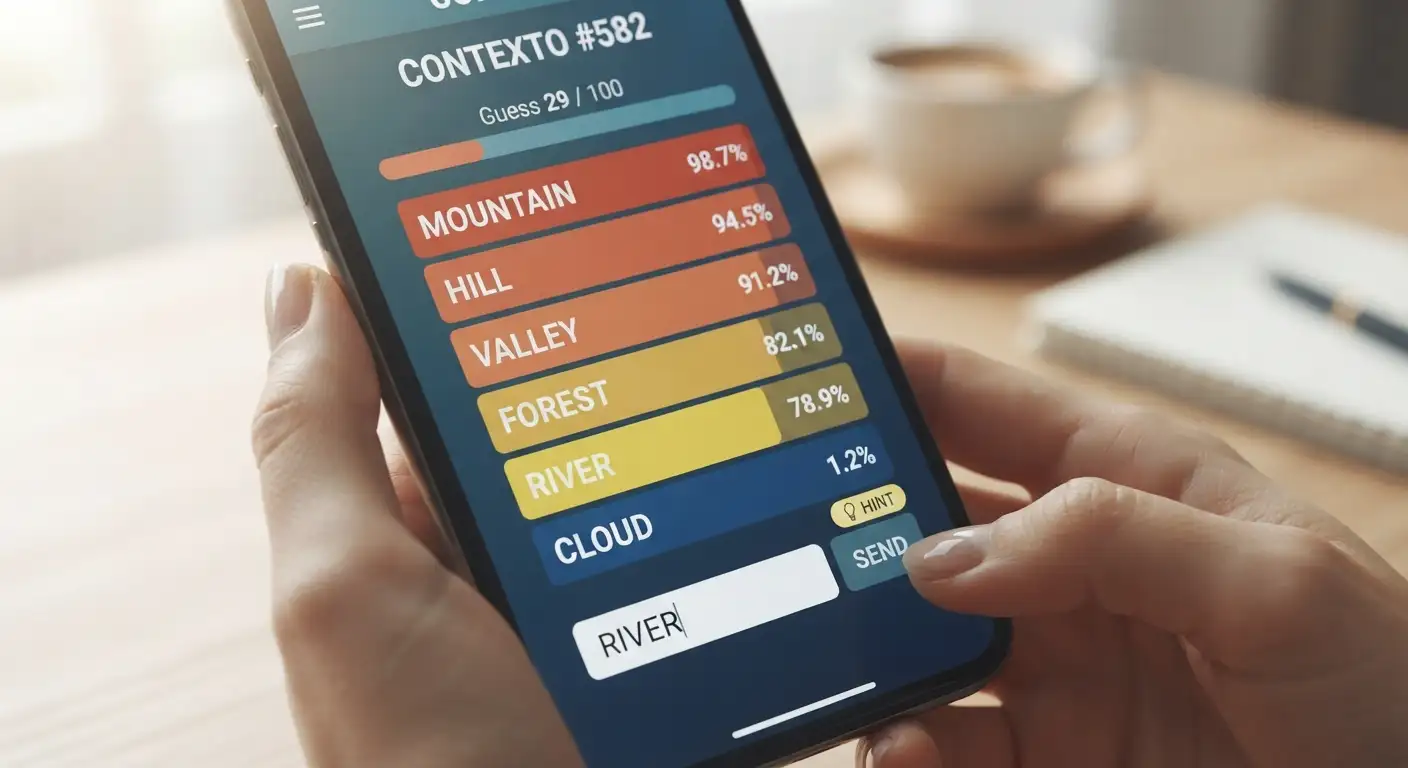
If you have spent twenty minutes hunting for a secret word and every guess lands in the red, you are in the right place. This page gives you Contexto hints, the Contexto answer today, and a look at the top 10 words that sit closest to it, so you can steer without losing the satisfaction of the final click. Today’s game is #1524, dated Friday, November 20, 2026.
Contexto is unlike most word games. There is no grid, no color-coded letters and no limit on attempts. Instead, you type any word you like, and the game tells you how semantically close it is to the secret word. Spelling does not matter at all, only meaning and usage.
Contexto Hints Today
Use these in order. The first hints tell you what kind of word you are chasing, which is the most valuable information in Contexto.
Hint 1 Word type
Hint 2 Domain
Hint 3 Meaning
Hint 4 Letters
Hint 5 Neighbors
Contexto Answer Today (Game #1524)
Tap to reveal today's Contexto answer
That is the Contexto secret word hint and answer for today. If you reached it by way of words like VIADUCT or TUNNEL, you were on exactly the right track: those sit in the same cluster as the answer. The gap between ‘close’ and ‘correct’ is often only a small shift in meaning, which is what makes this game both maddening and addictive.
Contexto Top Proximity Clues Today
One of the most useful tools for Contexto is a list of the nearest neighbors. These proximity clues are the words that sit closest to today’s secret word. They are shown here as a group rather than as exact ranks, because each solver’s numbers depend on which words they have already tried.
Tap to reveal the closest words (top 10 proximity clues)
Notice how strongly the AI groups concepts related to crossing waterways, valleys, and roadways together. Other transit and structural engineering terms fill out the surrounding ranks.
Two lessons come out of that list. First, the neighborhood is strictly about infrastructure, crossings, and geography. Second, the secret word sits right at the heart of spanning obstacles.
Contexto Semantic Category Guide
Most secret words fall into a handful of broad families. A reliable opening strategy is to probe a few families and see which ones turn green. This Contexto semantic category guide lists the families you will meet most often and what each looks like when it is hot.
| Category | Example probe words | Today |
|---|---|---|
| Infrastructure and Crossings | tunnel, road, river | Hot |
| Concrete objects | table, door, tool | Warm |
| Living things | dog, tree, bird | Cold |
| Food and drink | bread, soup, coffee | Cold |
| Actions and verbs | cross, span, link | Warm |
| Abstract ideas | future, choice, reason | Cold |
| Communication | report, story, word | Cold |
Probing is cheap because guesses are unlimited. Three or four deliberately different words, such as ‘water’, ‘dog’ and ‘future’, reveal the neighborhood quickly. Whichever lands in green or yellow tells you where to spend the next ten guesses.
How Contexto Ranks Words
Contexto compares your guess with the secret word using a language model trained on large amounts of text. Every word gets a position in a sorted list, and the secret word sits at number 1. The ranking reflects how often two words appear in similar contexts, not whether they mean the same thing.
That distinction explains most of the surprises. Related infrastructure and waterway concepts rank close to the answer because they are frequently mentioned in similar travel or engineering contexts. When a guess seems to rank too well or too poorly, remember that you are measuring usage, not definitions.
What this means for your guesses
- Think about situations, not synonyms. Ask where the word is used and who mentions it.
- Try related crossing and transit terms. Terms like tunnel, viaduct, and span rank right next to the answer.
- Adjust length after finding the category. Once you know it's a crossing structure, testing 6-letter words like BRIDGE helps pinpoint the answer quickly.
A Strategy That Finds the Secret Word Faster
Spend your first five guesses on breadth
Pick words from different families. Avoid guessing three similar items in a row, because the information overlaps.
Chase the trend, not the single best word
If five guesses all land in yellow, they probably share a theme. Name that theme, then think of the word that would sit at its center.
Use the hint button sparingly
Contexto’s hint reveals a word that is closer than your best guess so far. Use it to unstick yourself, not to skip the thinking.
Work backward from the letters
When a hint tells you the length or first letter, test candidates in your head against the cluster. A 6-letter crossing structure starting with B points straight to the solution.
Today’s game is a great example of central theme logic. A solver who finds TUNNEL, VIADUCT, and RIVER all clustered together might ask: what 6-letter structure spans a river or valley? That leads directly to the secret word.
Contexto vs. Other Word Games
Contexto sits in a different family tree from the grid-based puzzles that dominate the daily-game scene. Wordle asks you to reconstruct a five-letter word from letter feedback; Connections asks you to sort sixteen words into four fixed groups; Strands hides a theme word in a letter grid. Contexto does none of that. It gives you no letters, no grid and no fixed number of turns. What it gives you instead is a single number: how close your guess sits to the secret word. That one dimension changes the entire mental model of the game.
The practical effect is that Contexto rewards vocabulary and association rather than deduction. A player with a large passive vocabulary and a feel for how words cluster in real writing has a genuine advantage, which is why the game often feels less like a puzzle and more like a word-association test. The table below puts the contrast in concrete terms.
| Game | Core mechanic | Guess limit | Feedback given |
|---|---|---|---|
| Contexto | Type any word; measure semantic distance | Unlimited | A numeric rank and a color band |
| Wordle | Guess a 5-letter word | 6 attempts | Per-letter green / yellow / gray |
| Connections | Group 16 words into 4 categories | 4 mistakes | Correct group or “one away” |
| Strands | Find themed words in a letter grid | None (hints cost) | Highlighted words and a spangram |
| Spelling Bee | Build words from seven letters | None | Accepted / rejected, plus a rank |
The comparison also explains why Contexto feels forgiving one minute and brutal the next. With unlimited guesses there is no fail state, so a stubborn solver can grind toward the answer. But because a single guess can land anywhere from rank 2 to rank 30,000, there is no tidy feedback loop to follow. You are navigating a map with a compass that only points in a general direction.
Why Contexto Feels Different: The Semantic Neighborhood
Every secret word in Contexto sits at the center of a cluster of related words, and the shape of that cluster is what makes each puzzle unique. Some words have tight, obvious neighborhoods — dog is surrounded by cat, pet, puppy and animal, so most guesses land close. Others have sprawling, surprising neighborhoods, where destiny and horizon can rank near future without being synonyms at all. Learning to read the shape of the cluster, rather than chasing a single perfect match, is the real skill the game teaches.
Think of the secret word as sitting at the middle of a set of concentric rings. The innermost ring holds the words that share the most contexts — true synonyms, direct opposites, and close cousins like viaduct or overpass for bridge. The middle ring holds associated ideas that appear in the same conversations, such as river or tunnel. The outer ring is where the associations thin out into words that merely share a topic. Most players spend their early guesses jumping between rings without realizing it, which is why the ranks feel random. Once you notice which ring a guess landed in, the next guess becomes much easier to choose.
This is also why today’s answer is a satisfying teaching example. BRIDGE has a vivid, well-connected neighborhood, so a solver who starts with river or road will usually get warm feedback fast, while a solver who starts with tunnel will be right next door. Both are legitimate entry points. The ring model turns that surprise into information rather than frustration.
Recent Contexto Answers
Looking at earlier answers shows how the game alternates between concrete and abstract words. Here is the recent answer history.
| Game | Date | Answer | Type |
|---|---|---|---|
| #1524 | Nov 20, 2026 | BRIDGE | Concrete noun / Verb |
| #1509 | Nov 5, 2026 | PRACTICE | Abstract / Verb |
| #1508 | Nov 4, 2026 | WRITER | Concrete noun |
| #1507 | Nov 3, 2026 | BEAST | Concrete noun |
| #1506 | Nov 2, 2026 | APPEARANCE | Abstract noun |
| #1505 | Nov 1, 2026 | AIRCRAFT | Concrete noun |
| #1504 | Oct 31, 2026 | LIMIT | Abstract noun |
| #1503 | Oct 30, 2026 | HOLE | Concrete noun |
| #1502 | Oct 29, 2026 | BARN | Concrete noun |
| #1501 | Oct 28, 2026 | FOX | Concrete noun |
Infrastructure and crossing days like BRIDGE are often solved quickly by walking through river, road, and transit categories.
It helps to jot down your own category notes while you play. WebNotePad’s free memo notepad runs in your browser, so you can keep a running list of words you have tried and the colors they landed in, then paste your best finds into a note for tomorrow.
Contexto FAQ
What is today's Contexto answer?
The Contexto answer for November 20, 2026 (game #1524) is BRIDGE. It is tucked behind a tap in the reveal box so you can use hints first.
What are good Contexto hints for today?
The secret word is a concrete noun or verb with six letters. It starts with B, ends with E and refers to a structure built to span a physical obstacle such as a river, valley, or road.
What are the closest words to today's Contexto answer?
Words in the same semantic neighborhood include VIADUCT, OVERPASS, TUNNEL, RIVER, SPAN, CROSSING, CAUSEWAY, FOOTBRIDGE, AQUEDUCT and FERRY.
How does Contexto rank words?
Contexto uses a language model to rank every word by how similar its meaning and typical usage are to the secret word. The secret word is number 1, and the lower your guess number, the closer you are.
What do the Contexto colors mean?
Green marks words ranked roughly 1 to 300, yellow marks roughly 301 to 1,500, and red marks everything beyond that. Aim for green and use red guesses to rule out whole areas of meaning.
Is there a limit on guesses in Contexto?
No. Contexto allows unlimited guesses, and it also offers a hint button and a give-up option if you are stuck.
Why do Contexto rankings feel strange?
The rankings measure how words are used together in text, not dictionary definitions. A word that often appears alongside the secret word can rank above a true synonym.
Today’s Contexto word is a 6-letter crossing structure. Probe infrastructure, river, and transit categories, follow whichever turns green, and think about spanning obstacles.
Note the words you have tried and the colors they landed in, then reuse your best probes tomorrow.
Open the memo notepad →