Most Monday advice is about attitude. It tells you to be grateful for a new week, to think positively, to start the day with intention. None of that is wrong, but none of it is the actual problem. The problem is that Monday morning is the one moment in the week when you must switch from rest mode to work mode while the memory of rest is still fresh — and the work ahead looks largest and least tractable.
The quotes in this post are not chosen to lift your mood. They are chosen because each one names a specific mechanical problem with Monday, and each one points at a specific first move. Read them one at a time. Copy the one that lands. Then put it somewhere you will see it before the first meeting.
Why Monday Morning Is Different
Monday morning is where the weekend's optimism meets the week's calendar. Three things happen at once, and they all push in the same direction — away from starting.
- The work looks larger than it is. A task that is manageable on Wednesday looks enormous on Monday, because you are looking at it from a distance. The same distance makes it feel impossible to begin.
- You are out of the specific groove. Not out of skill, but out of the exact motions of the work. The first ten minutes on Monday are always slower than the first ten minutes on Tuesday, and that slowness is easy to misread as inability.
- You are choosing the wrong first task. The tasks that feel urgent on Monday morning — email, Slack, the calendar — are almost never the tasks that matter most. They are just the loudest.
A good quote for Monday does not try to solve all three. It solves the first one: it makes the start look smaller than the workload. That is the whole job of these five lines.
The 5 Quotes, Explained
Each quote below comes with a short explanation of why it works and where it is best used. Copy the one you need, skip the rest.
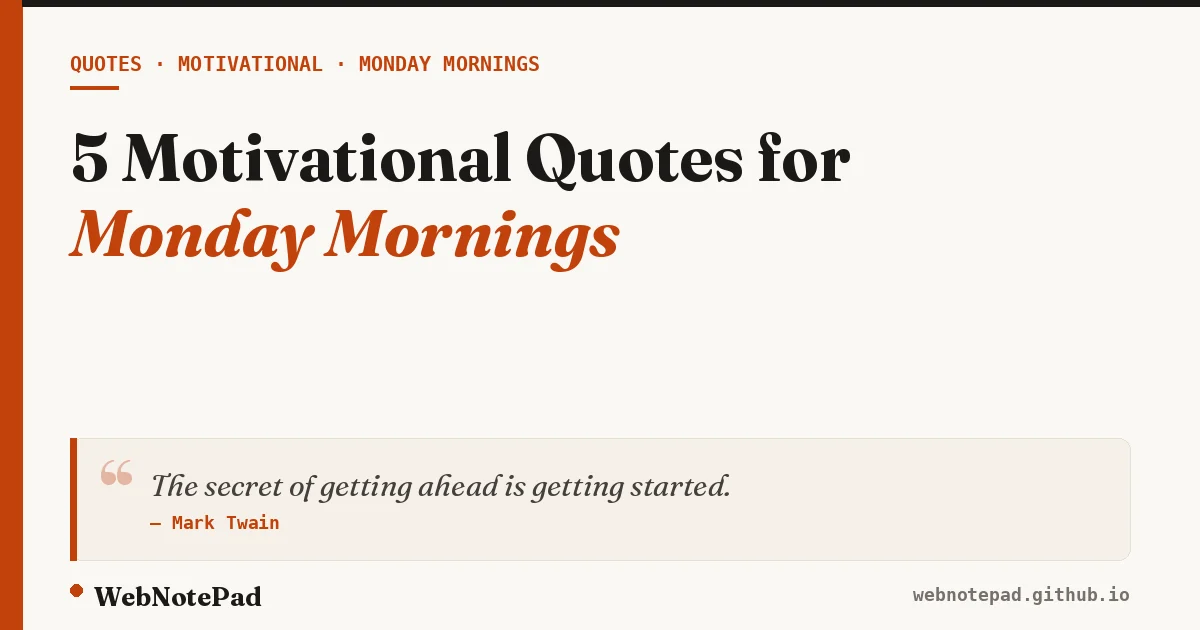
The secret of getting ahead is getting started.
Twain's line is doing something subtle. It replaces the word "ahead" — the thing Monday makes you anxious about — with "started" — the thing you can do right now. Best for the task you keep deferring to "later this week."
It always seems impossible until it is done.
Mandela's line is the antidote to the Monday illusion that the work is larger than it is. It says, correctly, that the size you see on Monday is a property of the distance, not of the task. Best for the project you have been avoiding for weeks.
You do not rise to the level of your goals. You fall to the level of your systems.
Clear's line is the most practically useful of the five, because it moves the question from "how do I feel?" to "what will I actually do?" On Monday morning, that shift alone is worth more than any amount of good mood. Best for anyone who is consistently optimistic on Sunday and consistently stuck on Wednesday.
Start where you are. Use what you have. Do what you can.
Ashe's three sentences are a check against the three classic Monday excuses: I am not ready, I do not have what I need, and I cannot do it all. The quote grants you permission to begin in the ordinary state you are actually in. Best for Monday mornings when you feel underprepared.
The way to get started is to quit talking and begin doing.
Disney's line is the shortest and bluntest of the five. It is the one to use when you have already thought about the task for three days and the thinking has become the problem. Best for people who plan more than they begin.
Five quotes, five different problems. If you only remember one thing from this post, remember this: pick the quote that names the specific reason you are not starting this morning. A quote that matches the problem is worth more than ten quotes that sound nice.
How to Use One Before 10 a.m.
Reading a quote does nothing on its own. Here is the specific method we recommend, and it takes about four minutes from the moment you open your laptop.
Pick one quote — only one
Not a list of five. The quote you pick should name the exact reason you are currently not starting. "The secret of getting ahead is getting started" if you are deferring. "You do not rise to the level of your goals" if the system is the problem. "Start where you are" if you feel unprepared.
Write it at the top of a fresh note
Open a new note in WebNotePad's free online notepad. Paste the quote. This takes ten seconds and it makes the quote real in a way a lock screen does not.
Answer it in one sentence
Write one line underneath the quote: "This week I will…" The sentence should be specific enough to be checkable on Friday. "This week I will finish the draft of section 2" is useful. "This week I will do better" is not.
Shrink the first action to 5 minutes
Below the sentence, write the smallest possible first action — the version that takes five minutes or less. Not "work on the draft" but "open the draft and rewrite the first sentence." This is what you do next. Everything else can wait until after the coffee.
If you do this every Monday for a month, the note becomes a record of what you actually promised yourself — and what you actually did. That record is more motivating than any quote on its own.
Copy any quote above with the ⎘ button, paste it into a free browser notepad that auto-saves. No account, no signup.
Open the free online notepad →Frequently Asked Questions
What is a good motivational quote for Monday morning?
Mark Twain's line — "The secret of getting ahead is getting started" — is the best of the bunch for Monday specifically, because it names the actual problem: not motivation, but starting. James Clear's "You do not rise to the level of your goals. You fall to the level of your systems" is the most useful for anyone who keeps failing to follow through.
How do you actually use a quote to get moving on Monday?
Pick one quote, write it at the top of a note, and write one sentence underneath it: "This week I will…" Then break that sentence into the smallest possible first action — a five-minute version. The quote is only useful if it produces that sentence.
Who said "It always seems impossible until it is done"?
Nelson Mandela. The line is widely attributed to him and appears in his speeches and interviews from the late 1990s onward.
What is the best book for Monday motivation?
James Clear's Atomic Habits is the most practical follow-up to the quote attributed to him here. It turns the idea of "systems over goals" into an actual weekly routine — which is what Monday really needs.
Are these quotes free to use?
The quotes themselves are widely published and quoted throughout the web. Copy them, save them, share them with attribution to the original author. Every quote card above includes a copy button so you can paste it straight into a notepad or note.