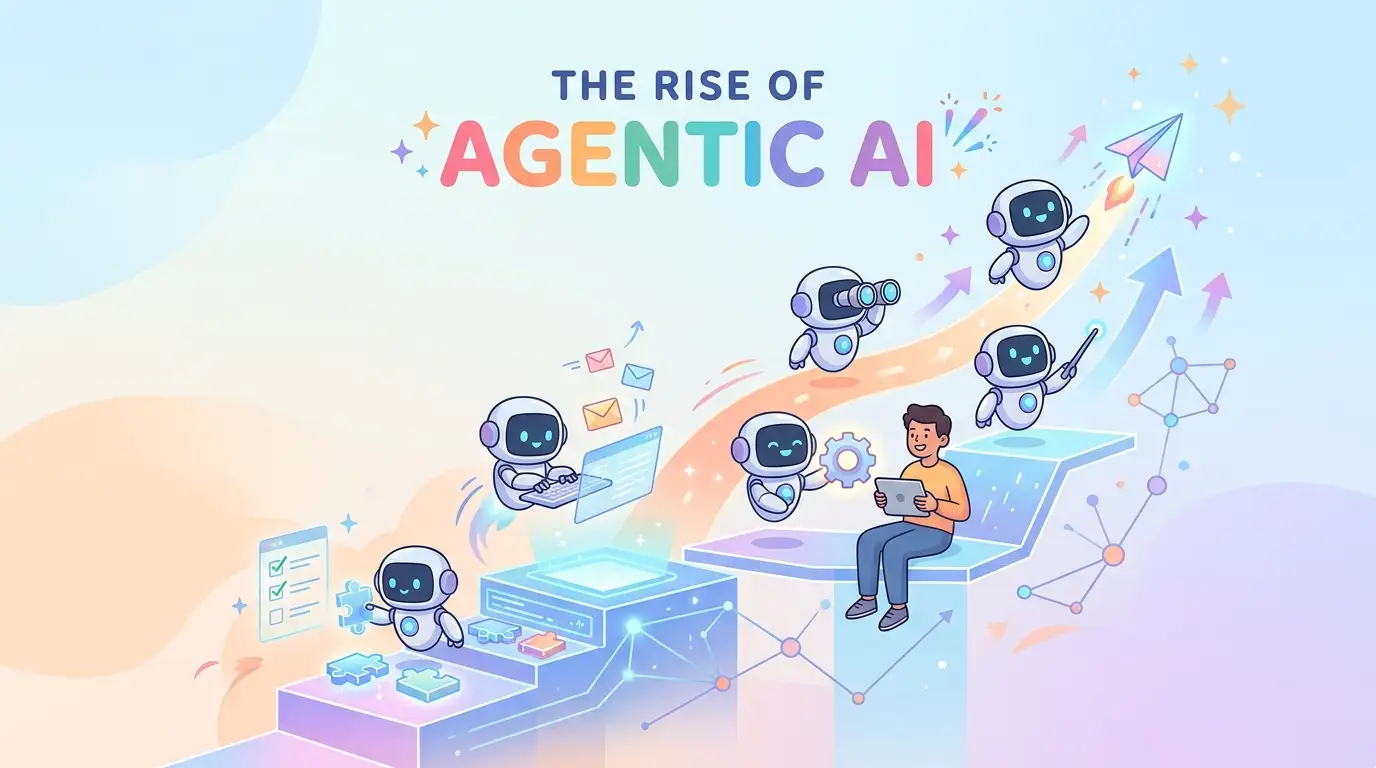
Throughout the early years of the AI boom, interactions with artificial intelligence relied on conversational chat boxes. Users typed a prompt, evaluated the generated text, copy-pasted snippets, and manually committed changes. In late 2026, tech engineering teams are witnessing a decisive shift toward Agentic AI—autonomous systems capable of navigating file systems, executing tests, debugging errors, and acting on user-defined goals with minimal supervision.
The Paradigm Shift: From Suggestion to Delegation
Traditional assistants lived primarily inside code sidebars or web interfaces, offering incremental autocomplete suggestions. Modern 2026 workflow agents run persistently inside sandboxed terminal environments, executing multi-file edits and running test scripts automatically before submitting results for review.
Traditional Chat Interfaces
Requires continuous prompt iteration, copy-pasting answers, manual code inspection, and user intervention at every step.
Autonomous Agentic Systems
Receives high-level objective, inspects repository context, executes code changes, runs unit tests, and verifies output self-sufficiently.
Why Command-Line & Terminal Agents Win
Command-line environments provide zero-overhead execution paths. Unlike heavy web UI wrappers, CLI agents interact directly with compilers, system utilities, and Git repositories. They can continuously verify whether their changes compile properly or break downstream services, reducing context switching for engineers.
Verifiability and Governance-by-Design
As enterprise adoption scales, safety frameworks have evolved from external policy enforcement to embedded governance-by-design. Systems log agent trajectories, track token utilization, and provide step-by-step diff validation so developers can inspect agent behavior before production deployment.
Engineering departments utilizing autonomous CLI agents report substantial gains in task throughput, reducing repetitive boilerplate writing while prioritizing review and architecture design.
The Role of Local-First Tools & Minimal Distraction
As systems become automated, lightweight and distraction-free developer tools have regained popularity. Instant tools—like client-side online notepads, quick text utilities, and local scratchpads—provide fast interfaces for drafting prompt specs and inspecting raw payloads without cloud sync friction.
Use WebNotePad for fast, auto-saving, local-first note-taking with zero registration or latency.
Launch Distraction-Free Notepad →2027 Tech Outlook
Looking ahead, multi-agent systems are set to become standard across continuous integration pipelines, automated security triage, and technical documentation generation. Organizations prioritizing lightweight, verifiable agent workflows are positioning themselves to set the software engineering standards for years to come.