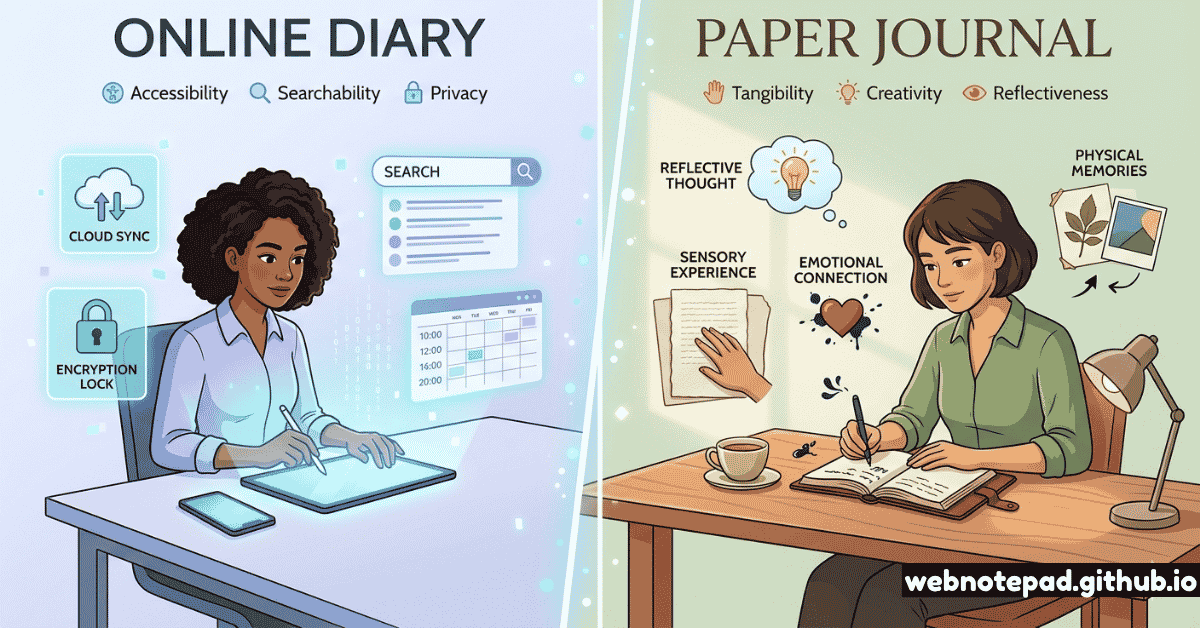
The paper journal has been humanity's trusted thinking tool for centuries. Marcus Aurelius kept one. Darwin kept one. Anne Frank kept one. There is something deeply primal about pen meeting paper that no screen has fully replicated. And yet — the world has changed. Our diaries need to be everywhere we are, need to be searchable, need to survive house fires and lost luggage, and increasingly need to be private from the people in our physical space.
This isn't an argument that paper journaling is wrong. It's an exploration of where each format genuinely wins — so you can make an informed choice rather than a sentimental one.
A browser-local online diary like WebNotePad stores all entries in your browser's local storage — never sent to any server, never accessible to any company. There is no database to breach, no cloud account to compromise, no employee who could theoretically read your entries.
If you share a device, you can clear site data after sessions. No other person opening the same URL can see your entries. The data is scoped entirely to your browser instance.
A paper journal is physically private — until it isn't. The risk surface is fundamentally different: it cannot be hacked, but it can be found. A family member, roommate, partner, or curious person who picks it up can read everything, instantly, with no technical knowledge required.
Many diarists self-censor on paper precisely because they fear discovery. That self-censorship — writing as if someone might read it — significantly undermines the psychological benefit of honest journaling.
Instant full-text search across every entry you've ever written. Type a word, phrase, person's name, or date fragment — every matching entry appears in under a second. After three years of daily entries, your diary becomes a searchable biography of your own thinking.
WebNotePad's diary also supports mood filtering and tag search — find all entries where you felt Anxious, or all entries tagged "work" or "travel," without scrolling through hundreds of pages.
Finding a specific entry in a paper journal means either remembering roughly when you wrote it and flipping to that date, or reading from cover to cover. With multiple journals spanning years, the search problem becomes genuinely severe.
Some diarists build paper indexes — but this adds significant overhead that defeats the simplicity advantage of paper. No amount of indexing approaches the speed of a digital search.
Your entire diary history is accessible from any device with a browser — your phone on the bus, your laptop in a café, a library computer in an emergency. A browser-local diary loads in under a second and works offline after the initial page load.
You never forget it at home. It's never damaged by rain or a spilled coffee. It takes up zero physical space in your bag.
A physical journal must be with you to be used. People who carry their journal everywhere have better habits — but this requires a bag large enough to hold it, the discipline to always bring it, and the willingness to write in public.
Multi-volume journal collections are completely inaccessible when you're traveling. You cannot browse last year's entries without the physical book in your hand.
Typing is faster than handwriting for most adults — typically 40–80 wpm vs 13–20 wpm — which means digital diaries capture thoughts more completely and with less physical effort. Auto-save means you never lose a word.
The digital interface lacks the tactile intimacy of pen on paper, but the speed advantage means thoughts are captured before they dissipate — particularly valuable for anxious writing, processing, and free-form stream-of-consciousness journaling.
Handwriting activates neural pathways associated with memory and emotional processing that keyboard typing does not. A 2021 study in Frontiers in Psychology found handwriting showed greater neural engagement in regions associated with learning and memory formation than typing the same content.
The slower pace of handwriting also encourages more deliberate thought. Many writers report that paper journaling feels more emotionally authentic — the physical act of writing feels like a ritual of care for one's inner life in a way that typing doesn't.
Digital data is fragile to browser clearing and device failure, but infinitely copyable. Use the Export HTML button in WebNotePad's diary to download a complete backup of all entries as a single file. That file can be stored on a hard drive, emailed to yourself, or printed.
Regular exports make digital diaries more durable than any physical medium — a digital file can exist in a dozen places simultaneously.
Paper is uniquely vulnerable: fire, flood, mold, and physical deterioration are real risks. But high-quality paper in dry conditions outlasts almost any digital format — medieval manuscripts exist in readable condition today. The physical object also feels irreplaceable in a way digital backups don't.
Historically important diaries — like those of Anne Frank or Samuel Pepys — survived precisely because they existed as physical objects that could be hidden, moved, and preserved by hand.
Mood tracking, streaks, full-text search, writing prompts, and HTML export. 100% private, stored in your browser only. No account required.
Open Free Online Diary →Digital diaries offer metadata that paper can't: automated date-stamping, mood tags per entry, full-text search, streak tracking, word count, and reading time estimates. This transforms your diary from a collection of writings into a structured personal dataset.
The online diary's mood filter reveals emotional patterns over months. Searching "project X" shows your evolving thinking about one topic across years of entries. Tags like "work" or "family" segment your diary into meaningful chapters.
Paper offers no automatic metadata beyond what you write. Mood tracking requires a deliberate system. Date stamping is manual. Tagging requires a separate index. The journal is exactly what you make it — flexible and deeply personal, but only as structured as your discipline imposes.
Some diarists love this — a completely free-form surface unbounded by any system. Others find the lack of structure leads to sprawling, unsearchable collections that gradually feel less useful.
The streak counter in a digital diary is a powerful behavioral trigger. Seeing "🔥 47-day streak" creates psychological loss aversion — breaking the chain feels costly. This mechanism, well-documented in behavioral science, significantly improves journaling consistency compared to untracked habits.
Digital diaries are also always accessible on your phone — the device you already check dozens of times a day. The habit has a natural home in your existing device behavior. Writing prompts remove the blank-page obstacle that kills paper journal sessions.
Paper journaling relies entirely on internal motivation and physical rituals. Many people report that the physical ritual — opening the journal, uncapping the pen — helps get them into a reflective state. But this ritual also means forgetting the journal, losing the pen, or simply not feeling like the physical act tonight causes skipped days.
Without a streak tracker or reminder system, paper journaling streaks are self-monitored and more easily rationalized away. "I'll write two entries tomorrow" — and then don't.
A free online diary like WebNotePad costs exactly nothing — now, and indefinitely. No premium tier for extra entries, no subscription after a free trial, no account fees. Unlimited entries, unlimited storage (up to your browser's local cap), forever free.
A decent paper journal costs £12–£40 per notebook, and most committed diarists fill 2–6 notebooks per year. That's £24–£240 annually for the notebook alone, plus pen costs. Over 10 years of journaling, paper is significantly more expensive than free.
Final Scorecard
The online diary wins six of eight rounds: privacy, search, portability, features, habit support, and cost. Paper wins one round definitively — the writing experience itself, where handwriting's neurological and emotional qualities are genuinely superior. One round (longevity) is context-dependent.
When to Choose Each Format
Choose Online Diary when...
- You want to search and reference past entries
- Privacy from people in your physical space matters
- You journal across multiple devices or locations
- You want mood tracking and streak accountability
- You struggle with consistency and need habit support
- You want to export, back up, or analyze your entries
- Budget is a consideration
- You type faster than you write by hand
Choose Paper Journal when...
- The physical ritual is important to your practice
- You journal as a meditative, slow-down activity
- You prefer handwriting for emotional authenticity
- Screen fatigue makes you want a screen-free option
- You value the physical artifact for its own sake
- You don't need to search or reference old entries
- You have a reliable dedicated journaling location
- The writing experience itself is more important than features
The Hybrid Approach: Get the Best of Both
Many dedicated diarists use both — strategically.
Morning practice (paper): Start each day with 5–10 minutes of longhand writing — stream-of-consciousness, morning pages style. The slowness and tactile quality support the meditative, intention-setting function of morning journaling. No searching, no tagging — just write and put it away.
Evening review (digital): End each day with a structured 5-minute digital entry — date, mood tag, what happened, how you feel, and what you're thinking about tomorrow. This is the searchable, archived layer. Over years, it becomes your most useful personal reference document.
Long-form processing (paper or digital): When working through a significant event, decision, or emotion — use whichever medium feels right in that moment. Neither is wrong. The important thing is writing at all.
Start with Digital — Add Paper Later
If you're building a journaling habit from scratch, start with the online diary. The streak counter, writing prompts, and zero-friction access are the most powerful habit-formation tools available. Once you've built the 30+ day streak and journaling is genuinely habitual, experiment with adding a morning paper practice alongside the digital one. By then, you'll know what you want from each format.
Paper journals are beautiful. They are intimate, they feel important, and the act of handwriting is genuinely neurologically distinct from typing. But for most people in 2026, a free online diary is the better journaling tool — it's more private in practice, completely searchable, always accessible, habit-supportive, and costs nothing. The most important decision isn't which format to use — it's to start writing at all. Start with the free online diary. Start today.