Every leader has a conversation on their calendar they would rather skip: the performance talk, the missed deadline, the feedback that might hurt. Delay rarely makes them easier.
These five quotes will not make the conversation comfortable. They are meant to make it clearer, kinder and more likely to happen at all.
Why We Delay the Hard Talk
Avoidance is rarely laziness. It is usually one of these.
- The dread feels bigger than the cost of waiting. The discomfort is immediate; the cost of delay is spread over weeks.
- The story grows. Without the conversation, you keep rehearsing the worst version in your head.
- Kindness gets confused with vagueness. Softening the message until it disappears feels considerate but leaves the person without what they need.
The quotes below help with all three: they treat honesty as a form of respect.
The 5 Quotes, Explained
Each quote below comes with a short explanation of why it works and where it is best used. Copy the one you need, skip the rest.
Criticism may not be agreeable, but it is necessary. It fulfils the same function as pain in the human body.
Churchill’s image is useful: pain is information. Leaders who avoid it leave problems untreated. Best for the feedback you have been softening.
The ultimate measure of a man is not where he stands in moments of comfort and convenience, but where he stands at times of challenge and controversy.
King’s line frames courage as something shown precisely when it is inconvenient. Best for the conversation you know needs to happen and keep rescheduling.
Facts are stubborn things.
Adams said this while defending soldiers in court, and it still works as a rule for hard conversations: start from what is observable. Best for emotional discussions that need a shared set of facts.
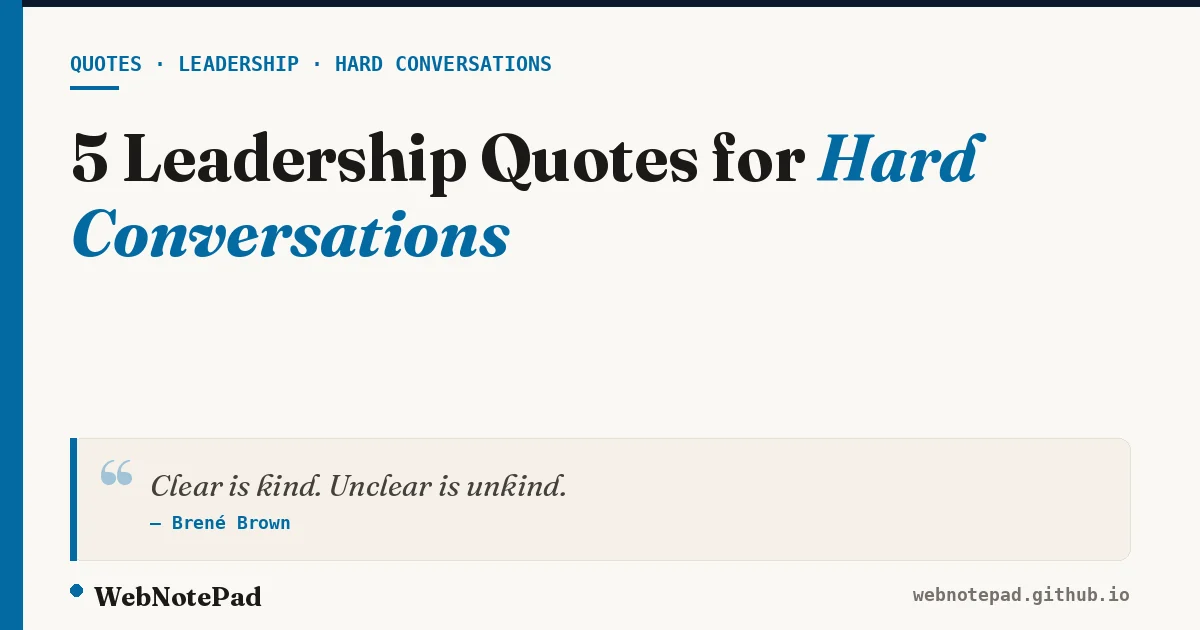
Clear is kind. Unclear is unkind.
Brown’s rule removes the false choice between honesty and kindness. Vague feedback feels gentle but leaves people guessing. Best for managers who over-soften.
Faithful are the wounds of a friend.
An old proverb with a modern point: honest words from someone who wants your success are a form of care. Best for feedback to people you respect.
Five quotes, five different fears. Choose the one that answers yours, then book the conversation.
Prepare in Five Minutes
A short structure keeps the conversation clear and kind.
Write the one fact
Describe what happened without interpretation: “The report was submitted three days late.”
State the impact
Explain the effect on the team, the client or the goal in one sentence.
Ask a real question
“What is making this hard?” Then listen. You may learn the cause is not what you assumed.
Agree the next step
Finish with one concrete action and a date to check in.
Write it down before the meeting. The act of writing makes the message shorter, clearer and kinder.
Paste your favourite quote into a private, dated entry and add one sentence of your own. It saves in your browser.
Open the online diary →Frequently Asked Questions
What is a good quote for a difficult conversation?
Brené Brown’s “Clear is kind. Unclear is unkind” is the most useful. Churchill’s line about criticism functioning like pain is a good reminder that honest feedback is necessary.
Who said “Facts are stubborn things”?
John Adams, in December 1770, while defending British soldiers after the Boston Massacre. He argued that wishes and passions cannot change the facts of evidence.
How do I start a hard conversation at work?
Start with one observable fact, state its impact, ask a genuine question and agree one next step. Keep it short, private and soon after the event.
Are these quotes free to use?
The quotes are short, widely published lines. Copy them, save them and share them with credit to the author. Where a line is only “widely attributed”, we say so; check the original source before using it in print. Every quote card includes a copy button for pasting into a notepad.