Leaders are usually rewarded for having answers, so they learn to speak first. The cost is that the people closest to the problem — who often know the most — stop offering what they see.
These five quotes make the case for the opposite habit: listen first, decide second. Pick the one that matches your next meeting.
Why Leaders Talk Too Soon
Speaking early feels like leadership. It often works against it.
- Authority anchors the room. Once the most senior person gives a view, others adjust to it instead of offering their own.
- Answers get the credit. Most careers reward the person who solves, so questions feel like a loss of status.
- Silence feels like delay. Waiting to hear everyone is uncomfortable, so the meeting rushes to a decision.
Listening first does not slow decisions down. It makes them better informed and easier for people to support.
The 5 Quotes, Explained
Each quote below comes with a short explanation of why it works and where it is best used. Copy the one you need, skip the rest.
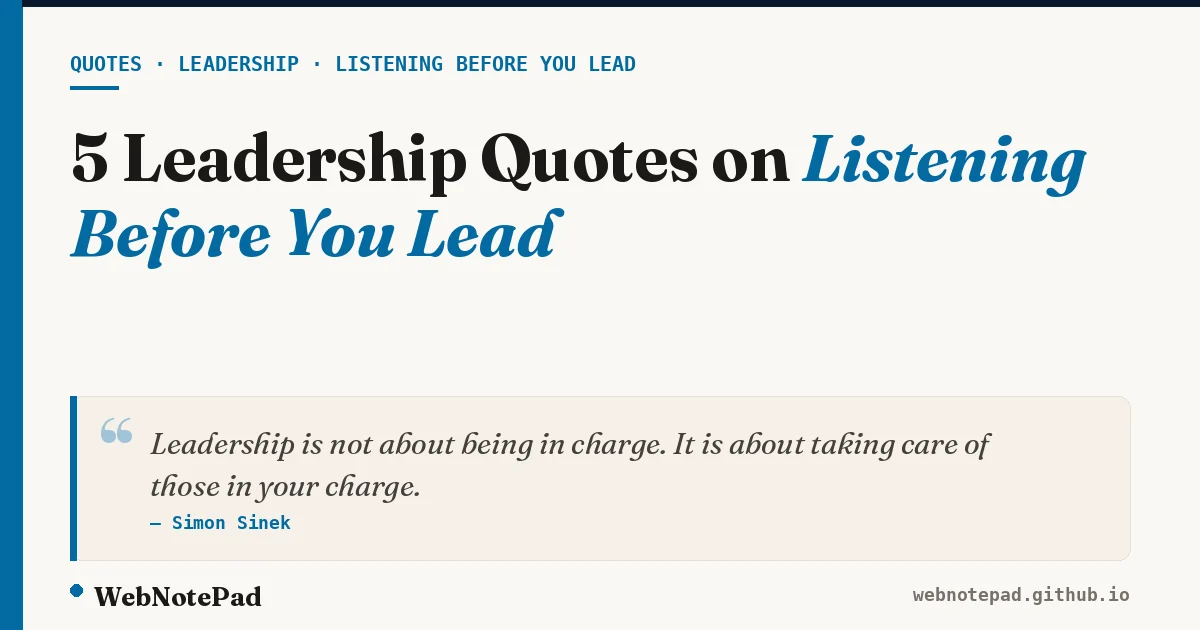
Leadership is not about being in charge. It is about taking care of those in your charge.
Sinek reframes authority as responsibility. Listening is the first act of that responsibility, because you cannot look after what you have not heard. Best for new managers.
Speak softly and carry a big stick; you will go far.
Roosevelt was describing restraint: strength shown quietly rather than announced. In a meeting, that means saying less first. Best for leaders who tend to fill every silence.
I am always ready to learn although I do not always like being taught.
Churchill’s joke contains a useful honesty: learning from others is often uncomfortable, and it is still necessary. Best for the moment you feel defensive about feedback.
Most people do not listen with the intent to understand; they listen with the intent to reply.
Covey describes the habit that ruins most conversations: preparing your answer while the other person is still speaking. Best for any one-to-one.
The most important thing in communication is hearing what isn’t said.
Drucker points at hesitation, tone and the topics people avoid. Best for leaders who notice that the quietest person in the room is often holding the key information.
Five quotes, five habits. Choose the one that fits the next conversation you are likely to rush.
A Listening Routine for Your Next Meeting
Four small changes, none of which need permission.
Ask first, speak last
Open with a question and hold your own view until everyone else has spoken.
Ask “What am I missing?”
Say it out loud, and mean it. It signals that disagreement is welcome.
Repeat back what you heard
Summarise the point in your own words before responding. Correction is cheap now and expensive later.
Pause before deciding
Take a full breath before announcing the decision. People often add the key detail in that gap.
Try it for one meeting this week and write down one thing you learned that you would otherwise have missed.
Paste your favourite quote into a private, dated entry and add one sentence of your own. It saves in your browser.
Open the online diary →Frequently Asked Questions
What is a good leadership quote about listening?
Covey’s line about listening to understand rather than to reply is the most practical. Sinek’s “taking care of those in your charge” gives the reason listening matters.
Who said “Most people do not listen with the intent to understand”?
Stephen R. Covey, in The 7 Habits of Highly Effective People. He uses it to introduce empathic listening as a core habit.
How can a leader become a better listener?
Ask a question before offering a view, repeat back what you heard, and leave a short pause before you decide. Practise in one meeting a week until it becomes automatic.
Are these quotes free to use?
The quotes are short, widely published lines. Copy them, save them and share them with credit to the author. Where a line is only “widely attributed”, we say so; check the original source before using it in print. Every quote card includes a copy button for pasting into a notepad.