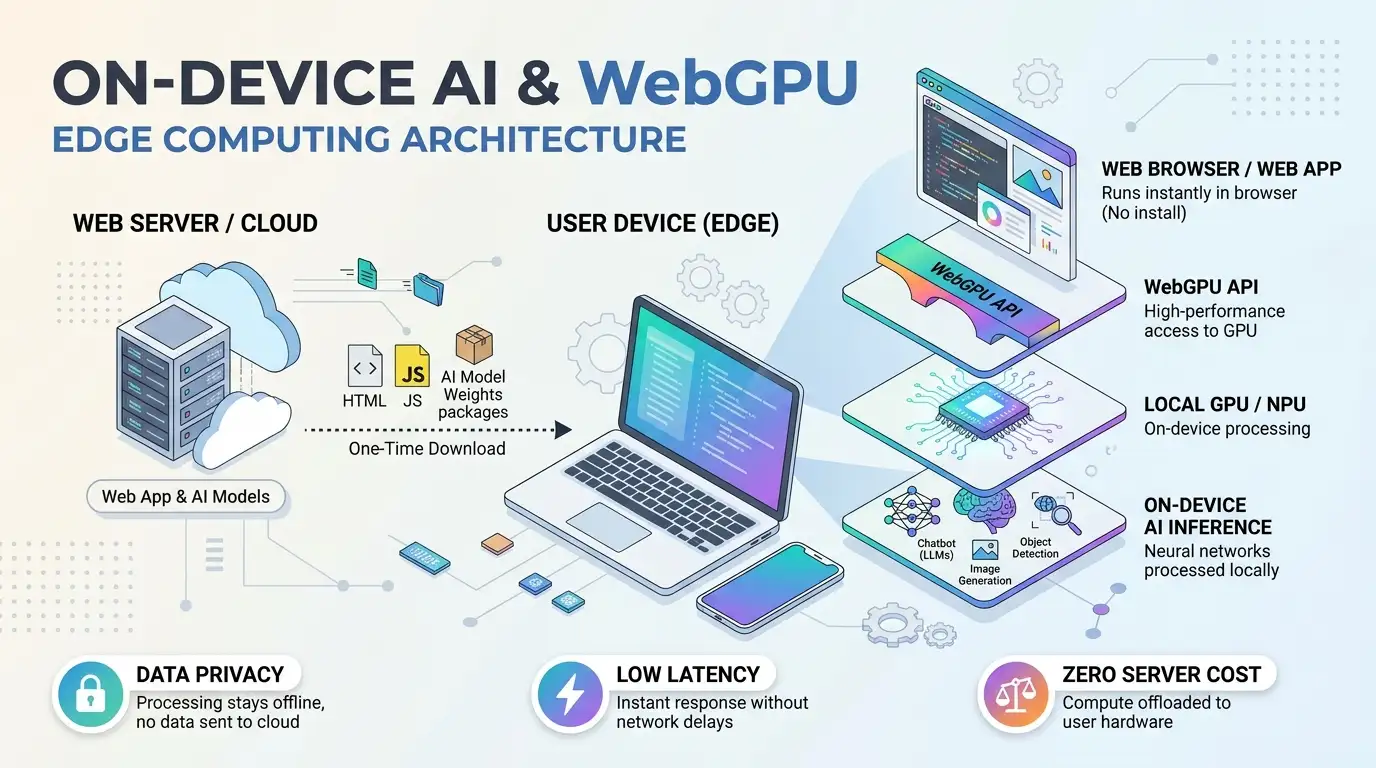
For years, software applications relied heavily on remote datacenter APIs to process artificial intelligence tasks. However, in late 2026, tech infrastructure is reaching a major turning point: On-Device Local AI. Driven by browser acceleration standards like WebGPU and efficient 2-bit to 4-bit model quantization, developers are running intelligent applications directly inside client hardware without sending sensitive payload data over cloud connections.
The Cloud API Bottleneck
As enterprise usage scaled, relying exclusively on remote AI endpoints exposed clear trade-offs: persistent network latency, recurring operational token fees, and strict regulatory hurdles concerning user data storage. Local execution eliminates external network dependency entirely.
Cloud API Dependency
Incurs continuous bandwidth costs, introduces round-trip latency, and routes sensitive data to third-party data centers.
On-Device Edge Computing
Runs directly on local NPUs and GPUs, provides sub-10ms response times, operates fully offline, and retains total privacy.
The Rise of Quantized SLMs
Engineering teams are finding that compact Small Language Models (SLMs) tuned specifically for focused tasks—such as code completion, document summaries, or text transformations—often match or exceed massive multi-billion parameter models in speed and usability when run locally on client devices.
WebGPU & Zero-Latency Browser Applications
Modern browser engines now natively accelerate matrix multiplication via WebGPU. Web applications can load optimized weights straight into local browser memory, allowing users to process notes, run code analysis, or translate formatting instantly—even when disconnected from the internet.
Local-first applications offer inherent reliability: user data stays stored on the client machine, application states persist across tab updates, and core editor utilities continue to function smoothly without active internet connections.
Privacy, Security & Data Sovereignty
Compliance standards in 2026 prioritize zero-trust architecture. Building tools with local storage and client-side processing guarantees compliance by design, ensuring private thoughts, drafts, and business documents remain solely in the control of the user.
Draft ideas instantly with WebNotePad—100% private, client-side auto-saving, offline-ready, and zero server logging.
Launch WebNotePad Free →Industry Outlook
As chip makers equip next-gen laptops and mobile devices with higher Neural Processing Unit (NPU) throughput, local-first web and desktop applications will become the industry standard for daily productivity software throughout 2027 and beyond.