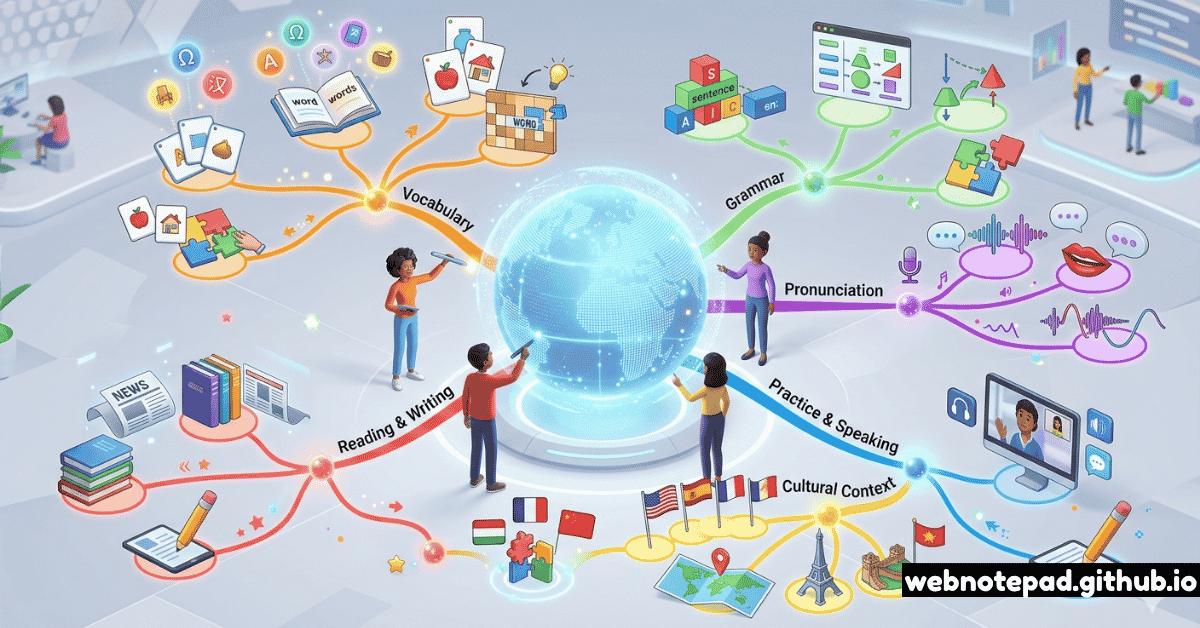
- Why Visual Learning Outperforms Flashcards
- 7 Mind Map Techniques for Language Learners
- Technique 1 — The Thematic Word Web
- Technique 2 — Grammar Pattern Map
- Technique 3 — Cognate & False Friend Map
- Technique 4 — Narrative Vocabulary Map
- Technique 5 — Cultural Concept Map
- Technique 6 — Conversation Prep Map
- Technique 7 — Spaced Repetition Review Map
- Which Languages Benefit Most
- Setting Up Your Language Learning System
The most common vocabulary learning method — writing a word, its translation, and a definition on a flashcard — is also one of the least effective for long-term retention. Words learned in isolation, without context or connection, are quickly forgotten. The brain doesn't store vocabulary alphabetically. It stores it in webs of association: meaning, sound, context, emotion, related words, and memorable images.
Mind mapping mirrors that architecture. A visual word web doesn't just teach you what wanderlust means — it teaches you its relationship to travel words, emotional words, German origins, English cognates, and the literary contexts where you'd encounter it. That network of connections is what makes vocabulary retrievable when you need it, in the middle of a real conversation, under real cognitive pressure.
Why Visual Learning Outperforms Flashcards for Vocabulary
The evidence for visual over rote learning in language acquisition is substantial and consistent:
Three principles explain this gap:
Associative Encoding
The brain forms stronger memories when new information connects to existing knowledge. A mind map forces you to link every new word to things you already know — semantically, phonetically, visually.
Dual Coding
Visual-spatial information is encoded in a separate neural pathway from verbal information. Mind maps activate both simultaneously, creating redundant retrieval paths that make recall more reliable.
Deep Processing
Building a mind map requires deciding relationships, making connections, and structuring information — cognitive work that creates deeper memory traces than simply reading and copying words.
Schema Building
Grouping vocabulary thematically builds mental schemas — organised knowledge structures that help you process and produce language faster, because related words are pre-grouped in memory.
7 Mind Map Techniques for Language Learners
Technique 1 — The Thematic Word Web
The thematic word web is the foundational language mind map. Take any broad topic you need vocabulary for — travel, food, emotions, work, health — and build an entire semantic field around it in one map.
Theme: "Food" in Spanish
Each first-level branch covers a sub-category. Each leaf is a target word with its translation. Color each branch differently in your online mind map.
Build-as-you-learn rule
Don't build the entire map at once. Start the map with what you already know. Each new lesson, new encounter with a word, or new context adds branches and leaves. A map that grows over time encodes the learning journey alongside the vocabulary — making every addition more memorable than a single study session would.
Technique 2 — Grammar Pattern Map
Grammar is often taught as rules to memorise. Mind maps reframe it as patterns to recognise — which is actually how native speakers store grammar, as muscle memory rather than conscious rules.
Central node: PARLER (to speak)
Branches: Present tense (je parle, tu parles…) · Past tense (j'ai parlé…) · Future (je parlerai…) · Subjunctive (que je parle…) · Irregular exceptions (aller, être, avoir with notes on why they break the pattern) · Common phrases (parler couramment, je ne parle pas…)
Grammar maps work particularly well for:
- Verb conjugation trees — one verb at the centre, all tenses as branches, with notes on irregularities as leaf annotations
- Preposition webs — one preposition (e.g., German auf) at the centre, with branches for accusative vs dative use, common collocations, and English equivalents
- Tense comparison maps — comparing two similar tenses (e.g., Spanish Preterite vs Imperfect) with branches showing when each is used and example sentences
Technique 3 — Cognate & False Friend Map
For learners of related languages (Romance languages, Germanic languages, Slavic languages), cognates — words that look similar and mean similar things — are a powerful shortcut to vocabulary. But false friends — words that look similar but mean completely different things — are dangerous traps.
Central node: "-TION words"
True cognates branch: nation/nación, action/acción, communication/comunicación — add branches showing the rule (English -tion → Spanish -ción)
False friends branch: "embarrassed" ≠ "embarazada" (means pregnant), "actually" ≠ "actualmente" (means currently) — colour these RED to flag danger
Near cognates branch: Words where spelling differs slightly but meaning is the same
Colour-coded nodes, unlimited branches, drag-to-reorder, PNG export for study materials. No account needed.
Open Mind Map →Technique 4 — Narrative Vocabulary Map
One of the most powerful and underused techniques: build a mind map around a story. Choose a simple narrative — a trip, a meal, a job interview, a day in the city — and map every word you'd need to tell or understand that story.
This works because narrative context is the most powerful memory anchor available. Words learned in story context are recalled more easily than words from lists, because the story provides retrieval cues: "what word comes after the part where they arrived at the train station?" Your brain remembers the story and the vocabulary rides along with it.
How to build a narrative vocab map:
- Write the story outline as the central node and first-level branches (Beginning → Middle → End, or scene by scene)
- Under each scene branch, add the vocabulary you'd need for that moment — setting words, action verbs, dialogue phrases, emotional responses
- Add colour to mark words you already know (green), words you're learning (yellow), and words you find difficult (red)
- Tell the story aloud using the map as a reference guide — this activates production as well as recognition
Technique 5 — Cultural Concept Map
Language and culture are inseparable. Words like the Japanese 木漏れ日 (komorebi) — sunlight filtering through leaves — or the Danish hygge — cosy social warmth — have no direct English equivalents because the cultural concept doesn't translate, only the approximation of it.
A cultural concept map builds vocabulary around ideas that are specific to the culture you're studying:
Central node: 間 (Ma) — negative space, pause, interval
Architecture branch: related terms for space and silence in design
Music branch: rest, pause, silence as expression
Conversation branch: meaningful pauses, chinmoku (silence), listening words
Related concepts branch: wabi-sabi, mono no aware, adjacent ideas
English contrast branch: how English treats negative space differently — makes the concept memorable by contrast
Technique 6 — Conversation Prep Map
Before a language lesson, language exchange, or trip, build a conversation prep map for the specific situation you're about to face. This is the most practical, immediately usable technique for intermediate learners.
Conversation Prep Map Structure
Central node: The situation (e.g., "At the doctor in Germany")
Branches: Questions I'll be asked · Answers I need · Medical vocabulary · Phrases for when I don't understand · Emergency phrases
Leaves: Actual sentences, not just words — "Ich habe Kopfschmerzen" (I have a headache), "Können Sie das wiederholen?" (Can you repeat that?)
Build it the evening before any high-stakes language situation. Review it immediately before. The preparation itself is the learning — by the time you walk in, you've processed these words a dozen times.
Pair your conversation prep map with a note in the online notepad where you write a post-conversation debrief: what words came up that you didn't have, what you struggled to say, what worked well. This debrief feeds directly into tomorrow's vocab additions.
Technique 7 — Spaced Repetition Review Map
The biggest weakness of mind maps as a learning tool is that they're often built once and never revisited. The spacing effect — reviewing material at increasing intervals as it consolidates in memory — is the single most evidence-backed technique in learning science. Your mind map becomes dramatically more effective when combined with scheduled review.
Day 1 — Build the map
Create your thematic or grammar map during study. Don't export yet — the act of building is the first encoding event. Add colour, make connections deliberately.
Day 3 — Add and test
Reopen the map. Without looking at the leaves, try to recall what should be on each branch. Then reveal the leaves and add any new vocabulary you've encountered since building it.
Day 7 — Colour-code retention
Change the colour of nodes you feel confident about to green. Leave uncertain words at their original colour. Red for words you consistently forget. Focus your next study session on red nodes only.
Day 21 — Export and archive
Export the map as PNG for your language learning folder. Use the online diary to write a progress note: how many words did you retain, what patterns emerged, what do you still find difficult?
Which Languages Benefit Most from Mind Mapping
| Language / Feature | Best Map Type | Why It Helps |
|---|---|---|
| Spanish / French / Italian | Cognate maps + verb conjugation maps | Large cognate overlap with English; gender/conjugation patterns benefit from visual structure |
| German / Dutch | Compound word maps + case maps | German compound words (Schadenfreude, Weltanschauung) map beautifully; case system visualised as branching rules |
| Mandarin / Japanese | Radical/character maps + cultural concept maps | Characters built from radicals — mapping radical meanings to characters creates a visual learning shortcut |
| Arabic / Hebrew | Root word maps | Semitic languages built on 3-letter roots — mapping a root (k-t-b = writing) to all its derived words is extremely powerful |
| Any language | Thematic word webs + narrative maps | Universal — vocabulary organised by theme and story is more memorable than alphabetical word lists in any language |
Setting Up Your Language Learning System
The complete system uses three tools from WebNotePad:
Mind Map — Vocabulary Visual Maps
Your primary vocabulary building tool. One map per theme (food, travel, emotions, work, etc.) or per grammar pattern. Build over time, not all at once. Export as PNG for review.
→ webnotepad.github.io/mindmapNotepad — Lesson Notes & Conversation Debriefs
After every lesson, language exchange, or immersion experience: open a new note and write what you encountered, what you didn't know, and what you want to add to your maps. This is the raw material that feeds map updates.
→ webnotepad.github.ioDiary — Language Learning Journal
Weekly reflection entries: how many words did you actively use this week, which map had the best retention, what do you want to focus on next week. Tracking progress is motivating and reveals which techniques work best for you specifically.
→ webnotepad.github.io/diaryWords are not units. They are nodes in a network of meaning. The learner who builds that network explicitly — visually, thematically, with connections and colour — will always outperform the learner who memorises isolated translations. A free online mind map is the closest digital tool to how language actually lives in the fluent mind. Build the network. The fluency follows.