- Why Randomizers Are a Legitimate Decision-Making Tool
- Understanding Decision Fatigue
- When to Use a Random Picker (and When Not To)
- Types of Randomizers: Wheels, Coins & Pickers
- How to Use the Decision Maker, Step by Step
- Combining Randomization With Real Evaluation
- 10 Everyday Uses for a Spin Wheel Decision Maker
- Using Randomizers for Group Decisions
- Frequently Asked Questions
Somewhere between "what's for dinner" and "which car should I buy," there's a huge range of everyday decisions that don't deserve the mental effort we give them. Not every choice needs a spreadsheet. Some just need a spin.
This guide covers when and how to use randomizers and decision wheels as a genuine productivity tool — not a gimmick — plus how to use WebNotePad's free Decision Maker to spin a wheel, flip a coin, or randomly pick from a list in seconds, right in your browser.
Why Randomizers Are a Legitimate Decision-Making Tool
It sounds counterintuitive: how can leaving a choice to chance be a good decision-making strategy? The answer is that randomizers aren't meant to replace judgment — they're meant to replace unnecessary judgment. Every day, you make hundreds of small decisions, and research on decision fatigue shows that willpower and decision quality both decline the more choices you make in a row.
A random picker offloads the low-stakes decisions so your mental energy stays available for the ones that actually matter — the ones worth a proper pros-and-cons list in a notepad, not a coin flip.
Understanding Decision Fatigue
Decision fatigue is well documented in behavioral psychology: the more decisions a person makes, the more their judgment deteriorates, and the more likely they are to default to either impulsive choices or complete avoidance. It's why choosing what to eat for dinner can feel exhausting after a long day of decisions at work — not because the decision itself is hard, but because your decision-making capacity is already spent.
The fix isn't to make every decision more carefully. It's to correctly sort decisions into two buckets:
- Decisions that matter — where the outcome genuinely differs based on your choice, and deserve real evaluation.
- Decisions that don't — where any reasonable option is fine, and the only cost is the time spent deliberating.
Randomizers exist for the second bucket. Recognizing which bucket a decision belongs to is the actual skill.
When to Use a Random Picker (and When Not To)
Good candidates for randomization
Choosing between restaurants you'd both enjoy, picking which chore to do first, deciding who goes first in a game, selecting a workout from a list you already like, or breaking a tie between two equally good options you've already vetted.
Poor candidates for randomization
Career decisions, major purchases, decisions involving other people's safety or finances, or any choice where the options genuinely differ in quality. These deserve a written evaluation, not a spin.
A simple rule: if you'd be equally satisfied no matter which option came up, randomize it. If you'd feel real regret over one outcome versus another, it doesn't belong on a wheel.
Types of Randomizers: Wheels, Coins & Pickers
Not all randomizers are the same shape. Different formats suit different decisions:
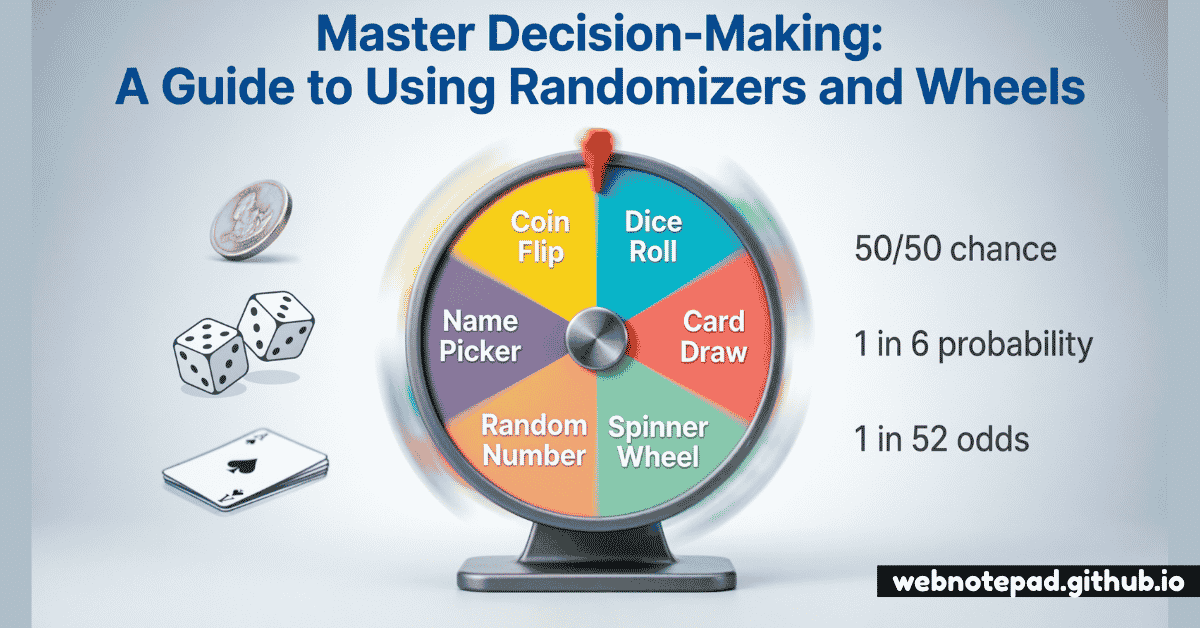
- Spin wheel — best for three or more labeled options, like choosing a restaurant, a movie genre, or which teammate presents first. Visually satisfying and easy for a group to watch.
- Coin flip — best for exactly two options, especially when they're truly equal, like choosing who goes first or deciding between two nearly identical choices.
- Random list picker — best when your options are already written down, such as picking one task from a long checklist to tackle first when everything feels equally urgent.
WebNotePad's Decision Maker combines all three in one free tool, so you can switch formats depending on the decision in front of you.
How to Use the Decision Maker, Step by Step
List Your Real Options
Open the Decision Maker and type in every option you'd genuinely be happy with. Leave out anything you wouldn't actually accept — a randomizer only works fairly if every listed option is a real possibility.
Choose Your Format
Pick the spin wheel for three or more options, or the coin flip for a clean two-way choice.
Spin — and Commit
Once the wheel lands, commit to the result. The entire value of a randomizer disappears if you re-spin until you get the answer you secretly wanted. If you notice yourself doing that, it's a sign the decision belonged in the "matters" bucket all along — pull out the Notepad and actually think it through instead.
Combining Randomization With Real Evaluation
The most effective use of a random picker isn't replacing judgment entirely — it's using judgment to narrow the field, then randomizing the final tie. This hybrid approach gets the best of both worlds:
- Brainstorm every possible option in MindMap, branching out from the central decision.
- Cut anything that's clearly worse than the rest — this is real evaluation, not randomization.
- Once you're left with two or three options you'd be equally happy with, hand the final call to the Decision Maker.
- Log the outcome in your Diary if it's a recurring decision — over time, patterns in what you "randomly" keep choosing can reveal a preference you hadn't noticed.
10 Everyday Uses for a Spin Wheel Decision Maker
- Choosing a restaurant when everyone says "I don't care, you pick"
- Picking which movie to watch from a shared watchlist
- Deciding who goes first in a board game or presentation
- Selecting a random workout from a list of exercises you already enjoy
- Assigning household chores fairly among roommates or family
- Picking a raffle or giveaway winner from a list of names
- Choosing which of several equally good job applicants to interview first
- Deciding which item on a to-do list to tackle right now
- Picking a random study topic to review during a revision session
- Settling harmless disagreements — like who does the dishes tonight
Using Randomizers for Group Decisions
Groups deliberate slower than individuals, and a visible, shared wheel spin removes a subtle source of friction: the appearance of bias. When a teacher, manager, or friend picks "randomly" by hand, someone always wonders if it was really random. A shared spin wheel, watched by everyone at once, settles the question instantly and fairly.
This works especially well for classroom activities, team task assignment, or picking presentation order — situations where the outcome doesn't matter much, but perceived fairness does.
Randomizers aren't a shortcut around thinking — they're a tool for recognizing which decisions don't need thinking at all. Save your mental energy for the choices that matter, and let a free spin wheel or coin flip handle the rest.
Spin a wheel, flip a coin, or randomly pick from your list — free, instant, and right in your browser.
Open Decision Maker →Frequently Asked Questions
What is decision fatigue?
Decision fatigue is the decline in the quality of your decisions after making many choices in a row. It's why small, low-stakes decisions late in the day feel disproportionately exhausting.
Is it a good idea to let a random wheel make decisions for me?
Randomizers work best for low-stakes decisions between options you would genuinely be happy with either way, such as choosing a restaurant or picking who goes first. For high-stakes decisions, use a random tool only to break a tie after you've already narrowed the options through real evaluation.
How does a spin wheel decision maker work?
You enter a list of options, and the wheel is divided into equal segments, one per option. Spinning it selects one option at random, giving each choice an equal, unbiased chance of being picked.
Can I use a random picker for group decisions?
Yes. A shared, visible spin wheel or random picker removes the appearance of bias when a group needs to choose between equally valid options, such as picking a presentation order or assigning tasks fairly.
Is WebNotePad's Decision Maker free to use?
Yes, the Decision Maker is completely free, runs in your browser, and requires no signup or account.